Flight Club Aerospace
A group of about twenty high schoolers designing and building a pt. 103 ultralight aircraft! In my 3.5 years on the team as a design team member, and later, design co-lead, I worked on the design of a part 107 ultralight and the design and fabrication of a 12’ wingspan prototype.
Website: https://www.flightclubaerospace.com/
Spring 2021
I was immediately tasked with simulating the fuselage for a full scale pt. 103 ultralight in Fusion 360’s FEA program. We started with simulations of lift at cruise (my notes on the forces), and went onto simulating forces on every part of the fuselage. Experimenting with Fusion simulation’s features — especially solving our last few simulations without constraints in rigid body mode — taught me a lot about breaking down forces and finding global equilibrium.
Our fuselage CAD was not perfect and the program had a tendency to fail meshing — runtimes were around five hours per simulation when they did work — so we had some strange workarounds, including putting spheres on the joints and removing most of the crossmembers from the simulation. The simulations showed us that we needed to push the beams at the bottom of the cabin backward to create a strong attachment for the aft spar.
Through the process we realized that our center of gravity was too far aft, which would make our plane unstable. We tried to remedy this by elongating the nose, but that didn’t fix the issue as much as we had hoped, opening up debate over switching to an aluminum fuselage, which would be lighter than the 4130 chromoly steel we had originally intended to weld.
Towards the end of March we met with Professor Jeff Hasson of Texas Tech, who suggested a few tweaks to the back of the cabin and doing simulations of roll forces, but otherwise approved our design. Professor Shirmohamadi also advised us on testing the wing attachment.
Overall, the process taught me to trust common sense before attempting to run something through a simulation — it’s faster that way.
Summer 2021
I started attending fabrication and learning shop skills — my first time doing so — mainly by building the wing. I enjoyed it, but design still remains my expertise.
After being elected Design Co-Lead, I led a subteam on control systems, designing the bellcranks for the rudder and elevator and researching cable strength. I also helped design the aileron bellcrank, doing some geometry so the aileron would go up more than down, and making a cardboard mock-up after the math got confusing.
We double checked our fuselage strength using a skewer and hot glue model, per the advice of some builders on the homebuilt airplanes forum — it worked! Moral of the story for both control systems and the fuselage: when in doubt, mock it up!
For the rest of summer I finished up small projects — designing braking for the landing gear, finalizing CG and pilot placement, and selecting a ballistic recovery system. We also redesigned the tail to improve static stability using XFLR5, which taught me about moments and aerodynamic coefficients. I did tail volume coefficient calculations to do a gut check on XLFR5’s results. We decided on a negative camber airfoil which was not ideal, but kept the tail reasonably sized.
I cozied up to the General Aviation Aircraft Design textbook to estimate drag so we could spec the motor.
Fall 2021
After training new recruits, I worked on the landing gear, namely calculating the force of impact to choose a spring. We didn’t finish, because in mid-August we met with Jump Aero, who told us that our front spars would probably break at high angles of attack. After a lot of heated debate, we decided to switch to designing a subscale prototype, which meant redoing our XFLR5 simulations and adjusting the tail size. I found that Reynolds scaling was impractical and got advice from Sanchit from Elroy Air to scale inertially. We decided on a model of about ⅙ mass, with wingspan ⅓ of our intended ultralight.
We continued discussing our design with Elroy Air, and switched from a cloth-covered wing to foam ribs with fiberglass. Justin from Elroy Air advised us on how to lay the fiberglass, and how to use a hot wire cutter to cut the foam into molds.
I led a subteam on CFD simulations to corroborate XFLR5 — something I only had an old blog post to help me with. After digging through forums, I learned how to visualize case files from SimScale in Paraview, then sliced them to get CSVs at one cross section of the wing with lift at each point. I fitted the data to a polynomial curve using some code, and created a desmos of chordwise lift distribution at different angles of attack.
Meanwhile we bought and tested several spars. I calculated some test cases using the Schrenk approximation and helped on one of our first successful tests.
At the end of the year, Nisu and I went to CNC the gussets for the spar at Kyle’s machine shop. He showed me how to use the Kitamura CNC — super cool!
Spring 2022
We began testing the new fiberglass wing design. I helped route the ribs and wrap them in fiberglass, then used my CFD chordwise lift distributions to design tests for rib strength — the rib held!
We also made our own hot wire cutter and cut foam molds, which was more difficult than expected because the long nichrome wire sagged, leading to wavy cuts. Our workaround was cutting using positive templates, over multiple passes.
The test wing’s fiberglass sagged between the ribs. We tried adding a bulkhead and a top hat, neither of which worked, so we increased the number of ribs and looped the fiberglass over the front edge.
Design finished up the remaining projects. I helped design the landing gear, mainly estimating forces. We used a carbon fiber leaf spring for the main gear, but the leaf spring for the front gear never arrived, so we built a rigid landing gear from square tubing instead.
For most of the spring I tried unsuccessfully to build a model of our plane in Gazebo. Our software lead eventually created one on a virtual machine, but it kept tilting inexplicably. I was able to get the model with joints working on a Mac, but the code for aerodynamic characteristics wouldn’t compile — there was an error with qmake that I tried running by Fischer and Karan from Elroy Air, but none of their solutions or the ones on stack overflow worked.
In preparation for the flight, I calculated our v-speeds and found them to be high but feasible.
Summer 2022
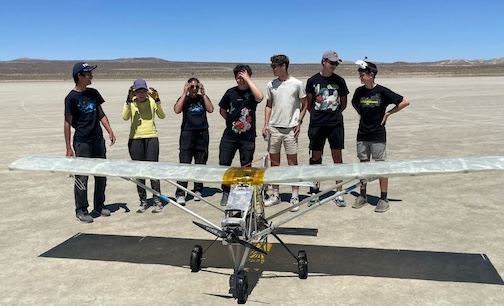
Leading up to the flight, Flight Club Aerospace focused entirely on fabrication. With the design finished, I helped build the fuselage and tail. We did taxi testing in Alameda on July 4. Our plane hit a pothole and tipped over, shattering the propeller and twisting the front landing gear. Thankfully, almost everything else was undamaged, so we were able to fix the landing gear, get a new propeller, and head to El Mirage Dry Lake for the test flight.
We first attempted a hop. The plane became airborne, but it landed too hard and the front landing gear collapsed. We weren’t able to fix the landing gear completely, so the plane wasn’t able to surpass stall speed on the ground. Our pilot tried a soft field takeoff, but the plane took off too early, stalled, and crashed. At which point we were out of spare propellers.
We took a break after the test flight — most of us were traveling or, in my case, sick.
Fall 2022
Besides redesigning the front landing gear to be solid piping with rubber shock absorbers, we also decided to extend the fuselage for more tail control. We redid XFLR5 simulations, deciding on a nearly twice as long fuselage for better static and dynamic stability, which I CADed. We also decided to redo the leading edge of our wings.
After training the year’s recruits, I led a team to calculate the dimensions of the new strut and verify the strength of the spar. We self-studied statics using Jeff Hanson’s videos and made a Desmos calculator after locking ourselves in a library conference room to grind through the calculations for a few hours. We also checked the strength of two fuselage beams that would be taking the force of the main landing gear and the pull of the struts.
We designed the gussets for the fuselage, and got really good at sketching and using the sheet metal tool. Tedious stuff, but necessary.
Spring 2023
I led a team to redesign the control systems; I designed the system for the elevator, using Fusion’s sheet metal tool yet again. Though not the failure point during the first flight, they weren’t as strong as they should have been, and we wanted to make them more lightweight.
Flight Club’s focus switched to fabrication for the second half of the spring, so I concentrated on training design members in CFD using SimScale and helping them become more confident with CAD with CAD challenges (I had a lot of fun helping Jay and Gracie piece together the twist strip challenge).
I fixed some last-minute problems as they came up, including redesigning the battery mount to be more secure, and fixing the rudder control system, which had an impossible-to-cut gusset.
Summer 2023
Because I attended SSP, I wasn’t able to attend the test flight. The plane crashed into a tent; it’s suspected that one of the control linkages broke, perhaps in addition to some lag in the system, but because the plane is almost completely destroyed no one’s sure what the failure was.
Fall 2023
Without a space to work out of, I focused on training new members and piecing together what happened during the flight. We decided to keep the same aircraft design, but improve fabrication techniques for a more reliable plane. We researched techniques to lay fiberglass as the leading edges on our previous wings sagged between the ribs. We also researched better hot wire cutter designs, eventually deciding on a design tensioned by weights, to ensure our molds would be even.